
Arlo Guthrie Convicted of Littering
The story of “Alice’s Restaurant” begins and ends at a church in Great Barrington, Massachusetts. By the 1960s, the small, pine Gothic Revival building had lost its congregation. The Episcopal diocese put the building up for sale, and in 1964, Alice and Ray Brock purchased it. After a formal de-consecration ceremony, the young couple moved in.
The Brocks were a creative and charismatic pair who had been influenced by Jack Kerouac and other members of the Beat Generation. Ray was an architect and woodworker, Alice a painter and designer. Both worked at a private school in nearby Stockbridge. They transformed the former church into a quirky but welcoming place where their students and other young people could find refuge from “establishment pressures,” especially the Vietnam War and the draft.
Ray and Alice served as surrogate parents for the young women and men who camped out, sometimes for weeks at a time, at the church. The neighbors were not happy about the arrangement. They viewed the Brocks and their guests as drug-using, long-haired hippies. Agitated residents honked their car horns and yelled as they drove past; they wrote letters to the editor protesting the presence in their community of what they called a “beatnik commune.”
It was in this context that police officer Bill Obanhein reacted so strongly when the church group was implicated in the Thanksgiving trash dump. That evening, the Brocks received a call from Obanhein. He had spent “two very unpleasant hours” going through the debris until he found an envelope with the Brocks’ name. Alice confirmed that Arlo and his friend were the culprits. Obanhein summoned the boys to the police station.
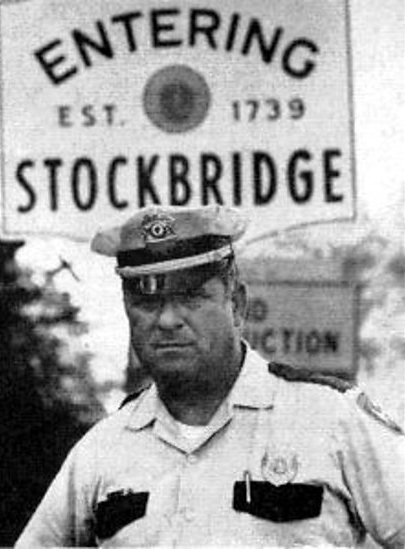
William J. Obanhein (October 19, 1924 – September 11, 1994), also known as Officer Obie, was the chief of police for the town of Stockbridge, Massachusetts. He was a member of the police force there for 34 years, 1951 to 1985. He is fairly well known for his appearances in popular culture.
Obanhein was the “Officer Obie” mentioned in Arlo Guthrie‘s 1967 talking blues song “Alice’s Restaurant“. Obanhein later said that some of the details in the song were not completely true; he said he had not handcuffed Guthrie during the arrest and said they removed the seat from the toilet in Guthrie’s cell to prevent theft, not suicide.[1] Obanhein later would note that he would not have arrested Guthrie had the amount of garbage been smaller (he would have picked up the garbage himself)[2] and that he meant to use the arrest and subsequent media circus as an example to deter any further large-scale littering incidents.
Obanhein accepted an offer from another Stockbridge resident, Arthur Penn, to appear as himself in the 1969 film adaptation of Alice’s Restaurant Penn was directing and co-writing.[3] Obanhein told Newsweek magazine (September 29, 1969, where his photo appears) that making himself look like a fool was preferable to having somebody else make him look like a fool.[4] Working on the film caused Obanhein to develop greater respect for Guthrie, and afterward, the two remained friends for the rest of Obanhein’s life.[5]
Obanhein posed for Norman Rockwell (himself a resident of Stockbridge) for a handful of sketches, including the 1959 black-and-white sketch Policeman With Boys, which was used in nationwide advertisements for Massachusetts Mutual Life Insurance Company (MassMutual).[6] He was also one of the models in Rockwell’s iconic The Problem We All Live With, though his face is not seen.[7] Obanhein also served as a model for Rockwell’s illustration of the inauguration of John F. Kennedy for a 1961 cover of The Saturday Evening Post.[8] He is sometimes mistaken (including on Guthrie’s website) for the officer who posed for Rockwell’s painting The Runaway, which appeared on a 1958 cover of The Saturday Evening Post; this was not Obanhein but Massachusetts state trooper Richard Clemens,[9] and the painting was instead set at Joe’s Diner in Lee, Massachusetts, not in Stockbridge.[10] On this day in 1965, 20-year-old Arlo Guthrie was convicted of littering in the Berkshire County town of Stockbridge, and the song “Alice’s Restaurant Massacree” was born. The son of legendary musician Woody Guthrie, Arlo and a friend were spending Thanksgiving with Alice and Ray Brock at the couple’s home in a former church. Alice asked the boys to take a load of trash to the town dump. When they arrived, they found that the dump was closed, so they threw the trash down a nearby hillside. Guthrie turned the story of their subsequent arrest and court appearance into a best-selling record. Thirty years later, he returned to the Berkshires. He purchased the former church building and converted it into an interfaith spiritual and social service center. The locals were not happy to see their town portrayed as a hippie haven, but many of them did enjoy being in the movie. Both Arlo and “Officer Obie” played themselves.
⇒MEDIA AREA⇐
Alice’s Restaurant Massacree The Movie
Movie Total Run Time- 1:59:46
Audio Version of Alice’s Restaurant Massacree Song
Song Total Run Time- 18:16
back to the story of ALICE’S RESTAURANT MASSACRE Song
They transformed the former church into a quirky but welcoming place where their students and other young people could find refuge from “establishment pressures,” especially the Vietnam War and the draft.
“Officer Obie” later admitted that he had no sympathy for longhaired, nonconformist teenagers, although he conceded that they were basically “good kids.” He decided to give them a scare and make an example of them so that the town would have no more trouble with hippies. He arrested the pair and put them in a jail cell until a furious Alice Brock bailed them out. Two days later, they appeared before a blind judge and his Seeing Eye dog, who “viewed” Obanhein’s photo evidence of the trash dumping and convicted the two young men of littering. He fined them $25 each and ordered them to clean up the trash.
After paying the fine and completing the cleanup, Arlo Guthrie began composing what would take up one entire side of his first album. Eventually 18 minutes long, “Alice’s Restaurant Massacree” evolved slowly over the next two years. The first verses written recounted the events of Thanksgiving 1965. Later Arlo added lyrics critical of the Vietnam War. When Alice Brock opened a restaurant in Stockbridge in early 1969, the song found its refrain, “You can get anything you want at Alice’s Restaurant.” Then, finally, there was the draft. Called before his New York City draft board for a hearing on his fitness for military service, Arlo faced a final question: “Have you ever been arrested?” In the song, his conviction for littering saves Arlo Guthrie from the draft. In reality he was classified 1A, but his lottery number never came up.
Called before his New York City draft board for a hearing on his fitness for military service, Arlo faced a final question: “Have you ever been arrested?”
When director Arthur Penn made a movie based on the song in 1968, he filmed on location at the former church; a number of the participants played themselves. Opening in the summer of 1968, one week after Woodstock, it was hailed as “one of the best films about young people ever made.” The locals were not happy to see their town portrayed as a hippie haven, but many of them did enjoy being in the movie. Both Arlo and “Officer Obie” played themselves.
Over the years, many people made pilgrimages to the building they called “Alice’s church.” In 1990 one of those pilgrims was Arlo Guthrie. To Guthrie, the community that had gathered there in the 1960s was not the failed utopia depicted in the movie but a place that nurtured enduring relationships. As he gazed through the windows into the empty building, he decided that there was still a spiritual presence there. As Alice Brock once said, “They had a ceremony to take God out of the church before we moved in, as though you can pick God up and place him here or there. I don’t feel like the church was deconsecrated. It was always a holy place.”
Over the next five years, Arlo Guthrie raised funds to purchase the building as a home for the Guthrie Center and Guthrie Foundation, a nonprofit interfaith organization, which brings together individuals for spiritual activities as well as cultural and educational exchanges.
Photo Album
| Header 1 | Header 2 |
|---|---|
THE GUTHRIE CENTER at the Old Trinity Church The Guthrie Center 2 Van Deusenville Road, Great Barrington, MA 01230 Phone: (413) 528-1955 Website:The Guthrie Center |     |
Woody Guthrie (Arlo Guthrie Father) Woodrow Wilson Guthrie (July 14, 1912 – October 3, 1967) was an American singer, songwriter, and composer widely considered one of the most significant figures in American folk music. His work focused on themes of American socialism and anti-fascism and has inspired many generations politically and musically with songs such as “This Land Is Your Land” and “Tear the Fascists Down“. For More Information on Woody Guthrie, please visit her Wikipedia® Page here Woodrow Wilson Guthrie
Married 3 times:
Nora Guthrie  Born: January 2, 1950 Spouse: Michael Kleff
Parents
Relatives:
| Marjorie Guthrie (Arlo Guthrie Mother)  Marjorie & Woody Marjorie Guthrie (née Greenblatt; October 6, 1917 – March 13, 1983), who used Marjorie Mazia as her professional name,[1] was a dancer, dance teacher, and health science activist. She was the daughter of American Yiddish poet Aliza Greenblatt (née Waitzman) and the second of three wives of folk musician Woody Guthrie, to whom she was married from 1945 to 1953. Her four children with Guthrie include folk musician Arlo Guthrie and Woody Guthrie Publications[2] president Nora Guthrie.
For More Information on Marjorie Guthrie, please visit her Wikipedia® Page here
Alice May Brock (February 28, 1941 – November 21, 2024) was an American artist, author and restauranteur. A resident of Massachusetts for her entire adult life, Brock owned and operated three restaurants in the Berkshires—The Back Room, Take-Out Alice, and Alice’s at Avaloch—in succession between 1965 and 1979. The first of these was the subject of Arlo Guthrie‘s 1967 song “Alice’s Restaurant“, which in turn inspired the 1969 film.
|
|


Location
This Mass Moment occurred in the Western region of Massachusetts.
Sources
- Arlo, Alice & Anglicans: The Lives of a New England Church, by Laura Lee (Berkshire House Publishers, 2000).
- The Guthrie Center Website
- A Mass Moment Website
Created 11/24/2025