

The Birth of Papermaking
AD 105 is often cited as the year in which papermaking was invented. In that year, historical records show that the invention of paper was reported to the Chinese Emperor by Ts’ai Lun, an official of the Imperial Court. Recent archaeological investigations, however, place the actual invention of papermaking some 200 years earlier. Ancient paper pieces from the Xuanquanzhi ruins of Dunhuang in China’s northwest Gansu province apparently were made during the period of Emperor Wu who reigned between 140 BC and 86 BC. Whether or not Ts’ai Lun was the actual inventor of paper, he deserves the place of honor he has been given in Chinese history for his role in developing a material that revolutionized his country.
Early Papermaking in China
Early Chinese paper appears to have been made by from a suspension of hemp waste in water, washed, soaked, and beaten to a pulp with a wooden mallet. A paper mold, probably a sieve of coarsely woven cloth stretched in a four-sided bamboo frame, was used to dip up the fiber slurry from the vat and hold it for drying. Eventually, tree bark, bamboo, and other plant fibers were used in addition to hemp.
The first real advance in papermaking came with the development of a smooth material for the mold covering, which made it possible for the papermaker to free the newly formed sheet and reuse the mold immediately. This covering was made from thin strips of rounded bamboo stitched or laced together with silk, flax, or animal hairs. Other Chinese improvements in papermaking include the use of starch as a sizing material and the use of a yellow dye which doubled as an insect repellent for manuscript paper.
Papermaking Spreads Throughout Asia
From China, papermaking moved to Korea, where production of paper began as early as the 6th century AD. Pulp was prepared from the fibers of hemp, rattan, mulberry, bamboo, rice straw, and seaweed. According to tradition, a Korean monk named Don-cho brought papermaking to Japan by sharing his knowledge at the Imperial Palace in approximately AD 610, sixty years after Buddhism was introduced in Japan. The Japanese first used paper only for official records and documentation, but with the rise of Buddhism, demand for paper grew rapidly.
Taught by Chinese papermakers, Tibetans began to make their own paper as a replacement for their traditional writing materials. The shape of Tibetan paper books still reflects the long, narrow format of the original palm-leaf books. Chinese papermakers also spread their craft into Central Asia and Persia, from which it was later introduced into India by traders. The first recorded use of paper in Samarkand dates from a battle in Turkestan, where skilled Chinese artisans were taken prisoner and forced to make paper for their captors.
The Spreading of Papermaking in Europe
From Samarkand, papermaking spread to Baghdad in the 8th century AD and into Damascus, Egypt, and Morocco by the 10th century. Many Chinese materials were not available to Middle Eastern papermakers, who instead used flax and other substitute fibers, as well as a human-powered triphammer to prepare the pulp.
It took nearly 500 years for papermaking to reach Europe from Samarkand. Although the export of paper from the Middle East to Byzantium and other parts of Europe began in the 10th and 11th centuries, the craft was apparently not established in Spain and Italy until the 12th century. Early paper was at first disfavored by the Christian world as a manifestation of Moslem culture, and a 1221 decree from Holy Roman Emperor Frederick II declared all official documents written on paper to be invalid. (The interests of wealthy European landowners in sheep and cattle for parchment and vellum may also have exerted some influence.) The rise of the printing press in the mid 1400’s, however, soon changed European attitudes toward paper.
The Papermaker
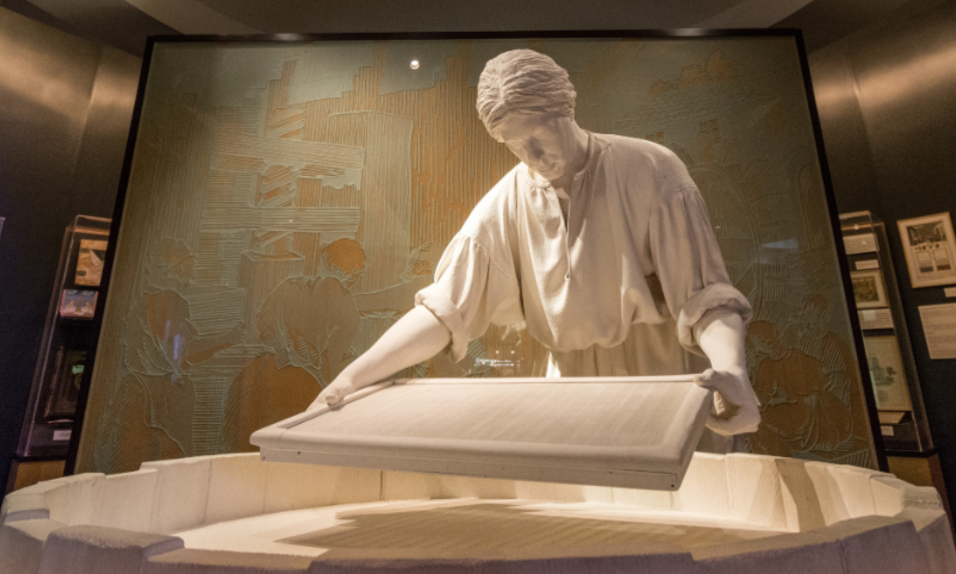
This life-size statue, which stands in the center of the Paper Museum, is an adaptation of an illustration entitled “The Papermaker,” which is believed to have first appeared in 1698 in the Book of Trades by Christopher Weigel. It next appeared in 1717 in the Book of Trades by Abraham van St. Clara, a copy of which is held by the Museum. The reproduction on which the statue is based appears on page 43 of Dard Hunter’s book Papermaking Through Eighteen Centuries (New York: William Edwin Rudge, 1930), which is also on display in the Museum. In all its forms, “The Papermaker” is an excellent introduction to the craft of papermaking in pre-industrial Europe.
The Process of Papermaking
Although the craftsman depicted in our statue would hardly recognize the equipment of a modern paper mill, the procedures he used to make paper were not that different from the processes of today. Preparing the stock, forming the paper web, drying the sheet, and applying coatings and additives were all as much a part of his work as they are of ours. Although many improvements in technology were made after the introduction of papermaking to Europe, the following description will give some impression of the operations which made up the papermaker’s craft.
Raw Materials for Paper
The material of choice for the European papermaker was cotton or linen fiber from rags. The rags were sorted, cleaned, and heated in a solution of alkali, at first in an open vat and later under steam pressure. After draining and seasoning, the rags were then washed and macerated to a pulp, which was then bleached to remove the final traces of dyes and the residual darkening from the cooking process.
Paper Molds
To form a sheet of paper, the papermaker dipped a paper mold into the vat of stock and lifted it out horizontally, trapping the fibers against the screen of the mold. Paper molds were made by hand from parallel lengths of wire laced together together with fine wire or thread (“laid” molds) or from woven wire mesh (“wove” molds).
Drying the Sheet
After forming, the sheet was removed (“couched”) from the mold and placed on felts or woolen cloth for pressing. A stack of paper sheets and felts, called a “post,” was placed in a large wooden screw press, and all the workers in the mill were summoned to tighten the press by pushing or pulling a long wooden lever. An average 2-foot post might be reduced to 6 or 8 inches in this way.
After pressing, the sheets were strong enough to be lifted from the felts and hung to dry, usually in groups of four or five known as “spurs” to prevent wrinkling and curling. Drying was usually carried out in the highest level of the mill, away from soot and dust.
Sizing and Finishing
To make the paper less absorbent, the dried sheet was dipped in animal gelatin or glue. Such sizing was more important for writing papers than for printing stock, since printing inks were thicker and did not soak into the paper so easily. The first method for smoothing the sheet was simply to burnish each sheet by hand with a glossy stone; a water-powered hammer smoother was developed in the early 17th century.
Papermaking Moves to the United States
The First Mill in America
The first paper mill in America was established in 1690 by William Rittenhouse near Germantown, Pennsylvania. In 1688, Rittenhouse left Holland, where he had been an apprentice papermaker, and settled in Philadelphia, near the print shop of William Bradford. The Rittenhouse mill remained the only mill in America until 1710, when William DeWees, brother-in-law to William Rittenhouse’s son Nicholas, established his own mill.
Most early mills in the American colonies were started by transplanted papermakers, like Rittenhouse, who modeled their operations on European mills of the day. These mills had to be located near populated areas that could provide a reliable supply of rags, the main raw material at that time. A generous supply of fresh water was also a requirement, both for washing the fibers and turning the mill machinery.
Paper for Printing in the Colonies
Many colonial paper mills, such as the Rittenhouse mill, were also located near print shops. Even before they had a reliable supply of paper, however, the colonies had begun to publish newspapers. The first newspaper in the colonies was the Boston News Letter, which appeared in 1705; the second was the Boston Gazette, first published in 1719. The third, also dating from 1719, was Bradford’s Mercury, which was published by Andrew Bradford, the son of printer William Bradford. To supply paper for the New York Gazette, William Bradford started a paper mill in New Jersey around 1726.
With the Stamp Act of 1765, Great Britain tried to raise revenue by taxing all colonial commercial and legal papers, newspapers, and pamphlets. Because of the export trade in paper, Britain attempted to restrict papermaking in the colonies, but due to the shortage of paper in America, these restrictions were not rigorously applied. It was only when colonial printers began to express their discontent with British rule that Britain really tried to control the production of paper.
Mold Making in the Colonies
Although some of the machinery used in early mills was imported from Europe, much of the machinery was constructed in the colonies. A high degree of craftsmanship was also required to create a paper mold; however, the lack of skilled mold makers in the colonies meant that many paper molds were imported from England.
Nathan Sellers of Pennsylvania was a skilled wire drawer who applied his craft to the manufacture of paper molds. Between 1776 and 1820, he supplied the molds for hundreds of American papermakers. This ability was so rare that, when Sellers joined the American army in the fall of 1776, he was soon discharged by a special resolution of the Contiental Congress, which sent him home to create the molds that were so desparately needed to make the paper used for powder wrappers and written orders during the Revolutionary War.
Paper Mill Construction After the Revolutionary War
By 1810, there were some 185 paper mills in the new United States. Ream wrappers were used to identify a mill’s products, and they were often printed with a picture of the mill. As existing mills expanded and new mills began production, rags for making paper became scarce, and the search for more plentiful raw materials began.
American papermakers began experimenting with alternative raw materials as early as the 1790’s, and many mills tested local sources of fiber as substitutes for rag pulp, including tree bark, bagasse (sugarcane waste), straw, and cornstalks. Wood pulp became a viable option thanks to the work of Mathias Koops in England and the increasing availability of mechanical wood grinders. The first US newspaper to be printed on paper made from ground wood pulp was the edition of the Boston Weekly Journal that appeared on January 14, 1863.
The Modern Paper Mill
The modern paper mill is a highly complex industrial facility. Although the principles of papermaking have not fundamentally changed for many years, a papermaker from Imperial China or pre-industrial Europe would be hard pressed to recognize his craft amongst all the equipment of a modern mill. To explore how a present-day paper mill operates, let’s follow the path of an individual wood fiber from its arrival at the mill to its departure.
Delivery and Preparation
Most of the mill’s raw material arrives by truck or rail in the form of logs. The logs are soaked in water and tumbled in slatted metal drums to remove the bark. The debarked logs are then fed into a chipper, a device with a rotating steel blade that cuts the wood into pieces about 1/8″ thick and 1/2″ square. (In some cases, the wood may have been chipped, bark and all, when it was harvested.) The wood chips are stored in a pile outside the mill; as new chips are added to the top of the pile, others are withdrawn from the bottom and carried by conveyor to the digester.
Pulping
Digesting is the process of removing lignin and other components of the wood from the cellulose fibers which will be used to make paper. Lignin is the “glue” which holds the wood together; it rapidly decomposes and discolors paper if it is left in the pulp (as in newsprint, which is usually made from groundwood pulp with little or no chemical treatment). Since this is a “kraft” mill, the lignin is removed by the action of sodium hydroxide (“caustic soda”) and sodium sulfate under heat and pressure. The chips are fed into the top of a digester and mixed with the cooking chemicals, which are called “white liquor” at this point. As the chips and liquor move down through the digester, the lignin and other components are dissolved, and the cellulose fibers are released as pulp. At the bottom of the digester, the pulp is rinsed, and the spent chemicals (now known as “black liquor”) are separated and recycled.
Bleaching and Refining
At this point, the “brownstock” pulp is free of lignin, but is too dark to use for most grades of paper. The next step is therefore to bleach the pulp by treating it with chlorine, chlorine dioxide, ozone, peroxide, or any of several other treatments. A typical mill uses multiple stages of bleaching, often with different treatments in each step, to produce a bright white pulp. Chlorine bleaching generally provides the best performance with the least damage to the fibers, but concerns about dioxins and other byproducts have led the industry to move towards more environmentally friendly alternatives.
At this point, the individual cellulose fibers are still fairly hollow and stiff, so they must be broken down somewhat to help them stick to one another in the paper web. This is accomplished by “beating” the pulp in the refiners, vessels with a series of rotating serrated metal disks. The pulp will be beaten for various lengths of time depending on its origin and the type of paper product that will be made from it. At the end of the process, the fibers will be flattened and frayed, ready to bond together in a sheet of paper.
Forming the Sheet
Once the pulp has been bleached and refined, it is rinsed and diluted with water, and fillers such as clay or talc may be added. This “furnish”, containing 99% water or more, is pumped into the headbox of the paper machine. From the headbox, the furnish is dispensed through a long, narrow “slice” onto the “wire”, a moving continuous belt of wire or plastic mesh. As it travels down the wire, much of the water drains away or is pulled away by suction from underneath. The cellulose fibers, trapped on the wire as the water drains away, adhere to one another to form the paper web. From the wire, the newly formed sheet of paper is transferred onto a cloth belt (or “felt”) in the press section, where rollers squeeze out much of the remaining water.
Coating, Drying, and Calendering
After leaving the press section, the sheet encounters the drying cylinders. These are large hollow metal cylinders, heated internally with steam, which dry the paper as it passes over them. The sheet will be wound up and down over many cylinders in the drying process. Between dryer sections, the paper may be coated with pigments, latex mixtures, or many other substances to give it a higher gloss or to impart some other desirable characteristic. After another round of drying, the paper sheet is passed through a series of polished, close-stacked metal rollers known as a “calender” where it is pressed smooth. Finally, the sheet is collected on a take-up roll and removed from the paper machine. From the headbox, it may have traveled half a mile or more in less than a minute.
Cutting and Packaging
In many cases, the new paper roll is simply rewound on a new core, inspected, and shipped directly to the customer. Other paper grades, however, may be further smoothed by passing them through a “supercalender” where the sheet is polished by passing between steel and hard cotton rollers (much like ironing fabric), or they may be embossed with a decorative pattern. The paper may also be cut into sheets at the mill, often by automatic equipment which accepts a roll of paper at one end and delivers packages of cut sheets at the other, already boxed and wrapped for shipping.
Papermaking today is one of North America’s most capital-intensive industries, devoting large sums of money to the development and construction of newer and more efficient equipment and processes. Although we ourselves might not recognize the paper mills of three hundred years from now, the same basic processes will almost certainly be in use to produce a product that will still be in demand far into the future.
Watermarks
European papermakers were the first to use watermarks. An offshoot of the guild system, the watermark served as a means of identifying the paper with the members of the trade organization who manufactured it. Just as with trademarks stamped into silver or firearms, the watermark indicated that the paper was the product of a trained artisan’s labors.
Wire Watermarks
Wire watermarks are formed by attaching a wire pattern to the mesh of a paper mold. When the paper slurry is drained of its water, the layer of residual fibers over the raised wire pattern is thinner than the rest of the sheet. When pressed and dried, these thinner areas result in patterns that only show clearly when held up to the light.
Light & Shade Watermarks
Light and shade watermarks are formed from relief sculptures impressed into the woven wire fabric of the paper mold. The image to be duplicated is first carved in wax, and the wax model is used to cast male and female plates. Heated wire fabric is placed between the two plates, which are pressed together; this causes the wire fabric to conform to the shape of the image. Paper cast on this type of mold is thinner in the raised areas of the image and thicker in the recessed areas, which creates a light and shade design.


The watermarks pictured are a portrait of Queen Elizabeth II from the time of her coronation in 1953 and a Madonna and Child watermark by Pietro Miliani Fabriano.


Dandy Rolls
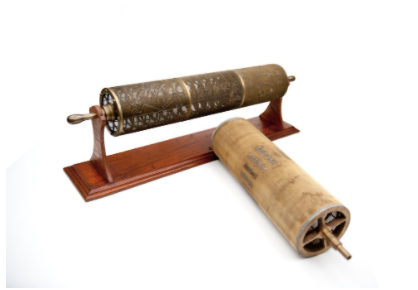
The invention of the paper machine created a need for a way to make watermarks on the continuous roll of paper. The “Dandy-Roll,” probably invented around 1825, was conceived to make an impression like a watermark by rolling over the damp paper just coming off the wire cloth of the paper machine. Dandy rolls can be of “laid” or “wove” design and can contain simple or intricate watermarking designs.
Resources
- History of Papermaking Around the World (PDF FILE)
- Crane 200 years of American, Handmade Stationery (Crane fine and sons Stationery)
Robert C. Williams Museum of Papermaking
This month’s artifact is a dandy roll. The dandy roll was invented in 1826 in England by a man named John Marshall, a maker of watermarks for handmade paper. After the invention of the Fourdrinier papermaking machine and the onset of industrial papermaking, he developed the dandy roll as a means of watermarking machine-made paper.
So, what is the difference between machine and traditional watermarking? In theory, not much. Both traditional watermark molds and the dandy roll involve thinning a pulled sheet of pulp in certain places in order to make a translucent design/mark on the surface of the paper. But instead of using a mold and deckle, the dandy roll is a hollow, metal cylinder that has a raised wire design attached to its surface. With industrial technology like the Fourdrinier papermaking machine, after a paper sheet has been formed it travels to the dandy roll which lightly rolls over it and presses a design into its wet fibers (at this point, the paper sheet will be approximately 97% water). Like a traditional watermark mold, as mentioned, the roll displaces and thins the paper fibers in the area where the design is pressed onto the sheet.
Our museum has a plethora of watermarking materials, dandy rolls among them. The first of our museum’s dandy rolls looks like a giant rolling pin and has “ABE GMS” embedded across its surface in wire. The other, accession number 941, has faces embedded onto its surface and is an example of how intricate and detailed watermarks and dandy roll designs can be.
Category:
Region of Origin:
The Robert C. Williams Museum of Papermaking’s mission is to collect, preserve, increase, and disseminate knowledge about papermaking – past, present and future.

 Dard Hunter, Paper Museum Founder
Introduction
The Robert C. Williams Museum of Papermaking melds art, history, technology and industry from historical and global perspectives. Museum visitors follow the path of paper from the earliest examples of writing materials, to the Chinese discovery of how to make paper, to the paper mills of Europe, and the high-tech machinery of today’s modern paper industry.
The Robert C. Williams Museum of Papermaking’s mission is to collect, preserve, increase, and disseminate knowledge about papermaking – past, present and future.
The museum cares for the most comprehensive collection of paper and paper-related artifacts in the world, comprised of over 100,000 artifacts including manuscripts, rare books, prints, hand and industrial papermaking tools and equipment, and crafted and manufactured objects, as well as paper samples.
The museum was first established in 1939 at the Massachusetts Institute of Technology by renowned paper historian Dard Hunter. In 1954, its founder relocated the museum to the Institute of Paper Chemistry in Appleton, Wisconsin, where it remained until 1989. At that time, the Institute of Paper Chemistry and museum moved to Atlanta, and the Institute was renamed the Institute of Paper Science and Technology (IPST). The museum became the Robert C. Williams American Museum of Papermaking in 1996 when the James River Corporation established an endowment in honor of its founder. In 2003, IPST merged with the Georgia Institute of Technology, and the museum became part of the larger organization. Today, the museum is part of the Renewable Bioproducts Institute, an Interdisciplinary Research Institute at Georgia Tech.
Permanent exhibitions trace the development of papermaking. Temporary exhibitions feature additional artifacts from the collections, artwork by leading contemporary paper artists, and national traveling exhibits.
The Paper Museum offers a variety of programs for audiences ranging from lectures for the general public to field trips for schools to hands-on workshops for all ages. Fee-based, hands-on workshops meeting Georgia Tech’s COVID-19 guidelines are offered in-person, and virtual programs are available as well.
Programming
The museum provides tour options for varying audiences, including Pre-K-12 students, scouts, college students, and adults. The museum also offers fee-based hands-on workshops and artists’ lectures on a variety of topics for artists, educators, and the general public.
School programs are age-appropriate and linked to Georgia Performance Standards. Tours and programs can be modified to meet the needs of specific classes.
Exhibits
The museum hosts both permanent exhibitions and changing galleries. The permanent exhibits trace the fascinating history of papermaking from its earliest antecedents through the advanced technology of today. There is also an exhibit that outlines the life works of Dard Hunter, the museum’s founder as well as galleries whose exhibits change covering topics as varied as art, history, and science.
Contact Us
Send mail to:
Robert C. Williams Museum of Papermaking
Renewable Bioproducts Institute
Mail code 0620, Georgia Tech
Atlanta, GA 30332-0620
NOTE: Please use zip code 30318 if sending via courier service (FedEx, UPS, etc)
Fax: 404-894-4778
Renewable Bioproducts Institute Main Line: 404-894-5700
Museum Director
Virginia Howell
Phone: 404-894-5726
Email: virginia.howell@rbi.gatech.edu
Museum Coordinator
Jerushia Graham
Phone: 404-894-7821
Email: jerushia@gatech.edu
Education Curator
Anna Doll
Phone: 404-894-7840
Email: anna.doll@rbi.gatech.edu
Create Your Own Paper! With Crane Museum of Papermaking
August 9 at The Mount
August 16 – 21 at Arrowhead!
Create Your Own Paper! With Crane Museum of Papermaking
Saturday, June 27, 2026, 11:00 a.m. – 4:00 p.m.
Enjoy a free community day at the Bidwell House Museum
On Saturday, June 27th the Bidwell House Museum is excited to present the Bidwell Artisan Fair. During this free community event, visitors to the Museum will have the opportunities to see numerous craftspeople creating items as varied as lace, chairs and paper. Many of the artisans will be using historical techniques and creating beautiful items in ways similar to New England craftspeople hundreds of years ago. In addition to craft demonstrations, visitors will also be able to see Revolutionary War reenactors demonstrating a “camp kitchen” and hear music from Shinbone Alley. There will also be a scavenger hunt for kids, snacks for purchase and from 12-2 the Los Lopez Taco Truck. Scroll down for a map of the event and a schedule. Paper copies of both will be available at the welcome table.